ŠTETL FEST
About the Festival
ŠTETL FEST is an international, multidisciplinary festival of Jewish culture held annually at the turn of August and September in Brno. It is dedicated to reviving the memory of places, personalities, and stories connected with Jewish history that was violently interrupted during the Second World War. The festival brings together a wide range of cultural and educational institutions and opens a space for dialogue on Jewish identity, memory, tradition, and contemporary life. The programme includes concerts, theatre productions, exhibitions, lectures, architectural walks, children’s workshops, and community events. Each edition focuses on a central theme reflecting historical experience in the context of contemporary society. The festival emphasizes the values of dialogue, openness, and respect, and through its dramaturgy fulfills its motto Dignity in Diversity.
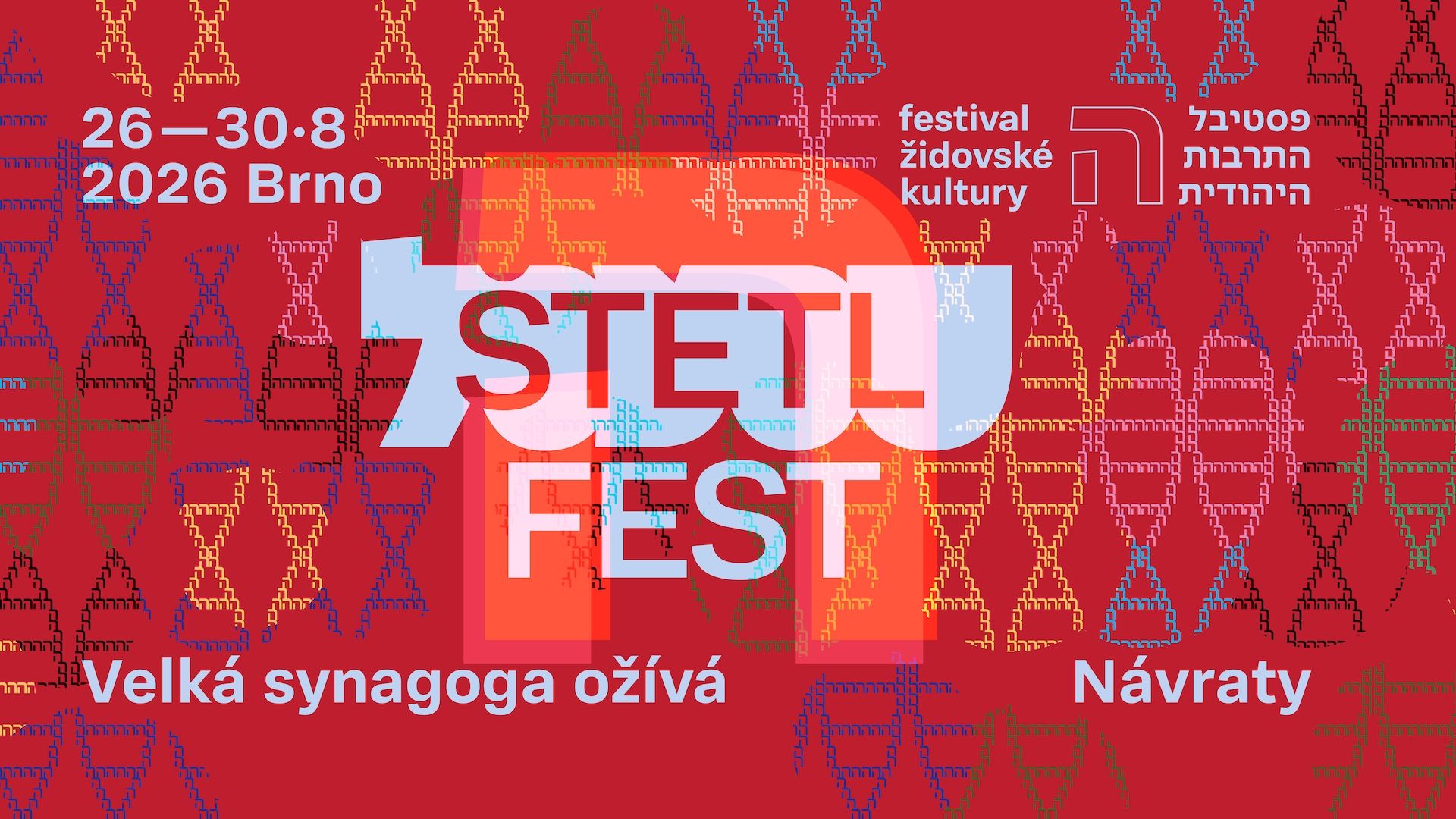
ŠTETL FEST – Fifth Edition of the International Multidisciplinary Festival of Jewish Culture
26–30 August 2026
Returns
There are places, seemingly empty and serene, whose silence is all but deafening. One such place can be found just outside of the former city walls, where the Great Synagogue of Brno stood until it was set alight by the Nazis in 1939. After decades of silence and no sign of recognition of its existence, the corner of Spálená and Přízova streets is set to become a meeting place once again. For a few days in August, at the fifth annual ŠTETL FEST festival, we will honour memory, revive dialogue, and celebrate together in an attempt to restore the voices drowned out by the flames of hatred.
Join us at the long table for Shabbat dinner and a festive Havdalah. We will transform the site into a vibrant Jewish market with music, Israeli cuisine, and family-friendly events, and we will symbolically bring the Great Synagogue back to life with outdoor video projections. We will also premiere Identity, a new stage production inspired by the stories of people from different generations and their relationship with their Jewish heritage. To permanently commemorate the Great Synagogue, we will install a Poesiomat featuring audio recordings of eyewitness accounts, liturgical chants, archival recordings, and contemporary texts inspired by the synagogue’s history and spirit.
This year’s theme, Returns, will bring to Brno the descendants of five Jewish families who profoundly shaped the city and its surroundings. The Placzek family represents a remarkable spiritual and intellectual heritage, from rabbis Abraham and Baruch Placzek to the physicist Georg Placzek, whose name resonated in the world of modern science with fateful urgency. Together, we will visit their former hometowns of Ivančice and Alexovice, where we will commemorate their legacy with a new publication and exhibition. A meeting with the descendants of the Löw-Beer family, prominent industrialists and patrons of the arts, will take us to villas in Brno and Svitávka as well as to the family’s textile factory in Brněnec, best known for the war-time tenure of Oskar Schindler. The Fuhrmann family produced globally renowned high-quality woollen carpets, which we will commemorate with an exhibition in the garden of Villa Löw-Beer – a building commissioned by Moritz Fuhrmann and later sold to Alfred Löw-Beer. The history of the Kohn family’s brickworks raises questions about property confiscations carried out by the Nazis and the subsequent restitution processes. Dramatic stories of confiscations and restitutions will also be shared by the descendants of the Stiassni family, primarily associated with elegant interwar architecture and the so-called Moravian Manchester phenomenon, and further explored in a series of discussions, lectures, and a live edition of the Rewrite History podcast.
An expert programme section will feature several memory institutions including the Jewish Museum in Prague, Center of Memory and Dialogue Bubny, the POLIN Museum of the History of Polish Jews in Warsaw, and the Documentation Centre for Property Transfers of the Cultural Assets of WW II Victims.
In addition to exploring the past, we also wish to focus on the future. We will announce the results of Time Machine: Places of Memory, a nationwide competition for children and adolescents, and screen the resulting short films dedicated to the exploration of lost places and their new-found meaning.
2026 marks the centenary of the birth of writer Arnošt Lustig. Meetings with his descendants, debates with experts, and contributions from younger generations will give us the chance to consider why his work continues to be an important part of European cultural memory.
Inspired by the ancient Kabbalistic practice of seeking answers in the Torah, the Israeli Fringe Theatre will present Goral Hagra, a mystical theatrical exploration of fate, faith, and memory.
The music programme will combine tradition and experimentation: the shtreimel-rocking Lea Kalisch will let loose at Goose on a String Theatre, the wild Israeli punk-jazz duo Malox will offer an alternative to traditional klezmer and spiritual songs, and the acoustic Folkadu will guide us through Jewish musical culture at Villa Tugendhat.
We will explore the world of contemporary Jewish thought with rabbis of international renown: Rabbi Eliezer Simcha Weiss, member of the Council of the Chief Rabbinate of Israel and a leading figure of global interfaith dialogue; and Elisa Klapheck, the first female rabbi in the Netherlands and a prominent figure of European liberal Judaism.
ŠTETL FEST 2026 invites you to a engage with history as a living part of the present. Returning to the past is not a nostalgic gesture, but rather a way to rediscover the city, its stories, and its seemingly quiet corners.
This work is licensed under
CC BY-ND 4.0


